
What Is Project Finance? The Structure Behind the Data Centre Boom
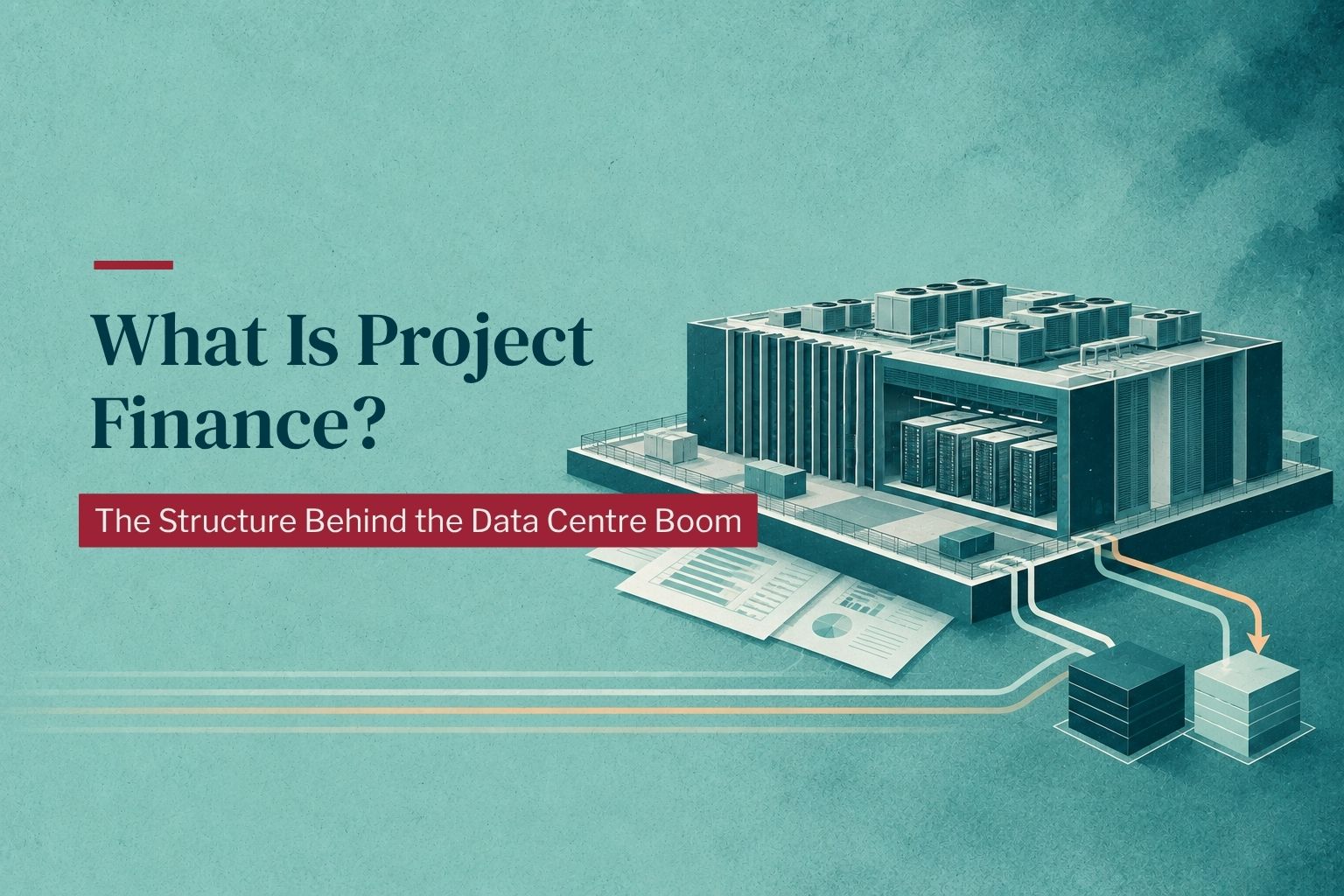
Project finance used to be a specialist discipline discussed mainly in relation to power stations, toll roads and pipelines. It is now front-page financial news, because the infrastructure being built for artificial intelligence is enormous, capital-intensive and increasingly funded with debt raised against the projects themselves. Understanding how a project is financed — as distinct from how a company is financed — has become useful well beyond the infrastructure teams that traditionally did this work. This guide explains the structure, the risk allocation that holds it together, and where the skills are in demand.
Project finance funds a specific asset through a standalone company created solely to own it, with lenders repaid from the cash that asset generates rather than from the balance sheet of the sponsors. Because the debt is typically non-recourse or limited-recourse, lenders underwrite the project itself, which makes contractual risk allocation central to the whole structure.
The core structure
In conventional corporate finance, lenders generally underwrite the operating company and its overall balance sheet and cash flows. In project finance, lenders primarily underwrite a ring-fenced project’s assets, contracts and cash flows. The sponsors create a new legal entity — a special purpose vehicle — whose only purpose is to build, own and operate one asset. That vehicle raises the debt, holds the contracts, and receives the revenue. Lenders look primarily to the cash flows generated by that single asset for repayment. If the project fails, the lenders’ claim is generally limited to the project and its assets rather than extending to the sponsors’ other businesses, which is what “non-recourse” means.
Why sponsors use it
The structure does several things at once. It ring-fences risk, so a failed project does not threaten the sponsor’s wider business. It allows higher leverage than a corporate borrower could normally sustain, because the debt is supported by contracted revenue. It lets several parties share ownership of a large asset without merging their balance sheets. And it makes very large projects possible for sponsors who could not fund them alone. The trade-off is complexity and cost: a project financing involves far more documentation, more advisers and a longer timetable than an ordinary corporate loan.
Risk allocation is the whole game
Because lenders cannot fall back on a sponsor’s balance sheet, every material risk has to be identified and contractually assigned to whichever party is best able to manage it. Construction risk usually passes to the contractor under a fixed-price, date-certain contract with penalties for delay. Operating risk passes to an operations and maintenance contractor. Supply risk is handled by long-term input agreements. Revenue risk is addressed by an offtake contract, in which a creditworthy buyer commits to purchase the output for years ahead. What remains unallocated is what the lenders are actually underwriting, and that residual is where the negotiation concentrates.
Why data centres changed the conversation
The scale of AI infrastructure spending has pushed these structures into the mainstream. J.P. Morgan has estimated hyperscaler capital expenditure at roughly $697 billion in 2026, and the largest operators raised around $108 billion of debt during 2025 as internal cash flow stopped covering the buildout. Companies that historically funded expansion from their own cash have moved toward debt and toward asset-level structures. A data centre with a long-term contract from a creditworthy tenant looks, financially, a great deal like a traditional infrastructure asset: large upfront cost, long life, contracted revenue. That resemblance is why project finance techniques are being applied to it.
| Dimension | Corporate finance | Project finance |
|---|---|---|
| Borrower | The operating company | A special purpose vehicle |
| Security | The company’s balance sheet | The project’s assets and contracts |
| Recourse | Full, to the company | Limited or none, to sponsors |
| Repayment source | Company-wide cash flow | Cash flow from the single asset |
| Leverage | Constrained by credit rating | Higher, supported by contracted revenue |
| Documentation | Relatively standard | Extensive and bespoke |
| Lender focus | Creditworthiness of the borrower | Robustness of the contract package |
Public private partnerships
A public private partnership applies the same techniques to public infrastructure. A government contracts with a private consortium to design, build, finance and operate an asset — a hospital, a school, a road, a water treatment facility — over a long concession period, after which the asset typically transfers to public ownership. The public authority pays either through availability payments, which are made provided the asset is available to the required standard, or by allowing the consortium to charge users directly. PPPs attract sustained debate about whether they deliver value for public money, and the answer depends heavily on how well risk was allocated at the outset.
The financial model is the deal
Project finance is unusually model-driven. A single financial model, built over months and audited by an independent modeller, sets the debt capacity, the repayment profile, the sponsors’ returns and the covenant levels. Two ratios dominate. The debt service coverage ratio measures cash available for debt service against the amount due in a given period; lenders require it to stay above an agreed minimum throughout. The loan life coverage ratio compares the present value of cash flows over the remaining life of the loan to the outstanding debt. Because these ratios determine how much can be borrowed, the model is not a supporting document — it is the commercial negotiation, expressed in numbers.
Concessions and asset transfer in PPP structures
In many PPP and concession-based project financings, the project company operates the asset for a defined concession period before transferring it to the public authority. A concession agreement grants the project company the right to build and operate the asset for an agreed period — commonly twenty to thirty years for major infrastructure — after which the asset transfers to the grantor, usually a public authority. That end date shapes everything upstream. The debt must be repaid within the concession, with a margin of comfort, so the loan tenor is set inside it. The maintenance obligations are written so the asset is handed over in a specified condition rather than run down toward the end. And the sponsors’ returns must be earned within that window, which is why the early years of a concession attract such close attention during structuring.
Careers in project finance
The work sits across several institutions: infrastructure and energy teams at investment banks, development finance institutions and multilateral lenders, infrastructure funds on the equity side, sponsor companies in energy, transport and increasingly technology, and specialist advisory practices. Junior roles centre on building and running the financial model, reviewing the contract package for risks that have not been allocated, and preparing credit and investment committee materials. The distinguishing skill is the ability to hold the commercial, legal and financial pieces together at once, because in this discipline a contractual term and a modelling assumption are frequently the same thing viewed from two directions.
Who sits around the table
A project financing involves more parties than almost any other transaction type, which is a large part of why it takes so long. The sponsors provide the equity and develop the project. The lenders — commercial banks, institutional investors, development finance institutions or export credit agencies — provide the debt. The construction contractor builds it, and the operations and maintenance contractor runs it afterwards. The offtaker buys the output. The host government grants permits and, in a concession structure, awards the contract itself. Around them sit legal counsel for each side, a technical adviser reporting to lenders, an insurance adviser, a model auditor and often an environmental and social consultant. Every one of those parties has a contract with the project company, and it is that web of contracts, rather than the borrower’s balance sheet, that lenders are ultimately relying on.
How NYIF covers project finance
The Project Finance and the Public Private Partnership Professional Certificate: Online ($1,590, 17 hours) covers the structuring of project financings and the specific characteristics of public private partnerships — the risk allocation framework, the contract package, and how concession structures work in practice.
Because the discipline is model-led, it pairs naturally with the Online Professional Certificate in Corporate Finance ($1,690, 60 hours) and with Fundamental Excel Skills for Finance for candidates who want to strengthen the modelling foundation first. For those focused on the lending side, Credit Analysis ($290, 14 hours) covers the underwriting fundamentals.
Browse the next available cohort on the 2027 course calendar.
People Also Ask
What does non-recourse actually mean?
That lenders’ claims are limited to the project company and its assets, and do not extend to the sponsors’ other businesses. In practice many financings are limited-recourse, with sponsors providing guarantees during construction that fall away once the asset is operating reliably.
What is an offtake agreement?
A long-term contract in which a buyer commits to purchase the project’s output at agreed terms. It converts uncertain market revenue into contracted revenue, which is usually what makes the debt financeable in the first place.
Why is leverage higher in project finance?
Because the revenue is contracted rather than market-dependent, and because risks have been contractually allocated to parties able to bear them. Predictable cash flow supports more debt than the same amount of uncertain cash flow would.
Are data centres genuinely project financed?
Increasingly, yes — particularly where a facility has a long-term contract with a creditworthy tenant, which gives it the contracted-revenue profile lenders look for. Much AI infrastructure is still funded on corporate balance sheets and through corporate debt issuance, so both models are running side by side.
What is a DSCR?
The debt service coverage ratio: cash available for debt service divided by the debt service due in the same period. Lenders set a minimum that must be maintained throughout the loan, and the ratio is one of the main constraints on how much can be borrowed.
Continue Your Finance Education
Ready to Advance Your Finance Career?
Browse NYIF courses in capital markets, risk management, financial modeling, and more.
Browse the 2026 Course Calendar →