
What Is Asset Management? Roles, Strategies, and Career Paths
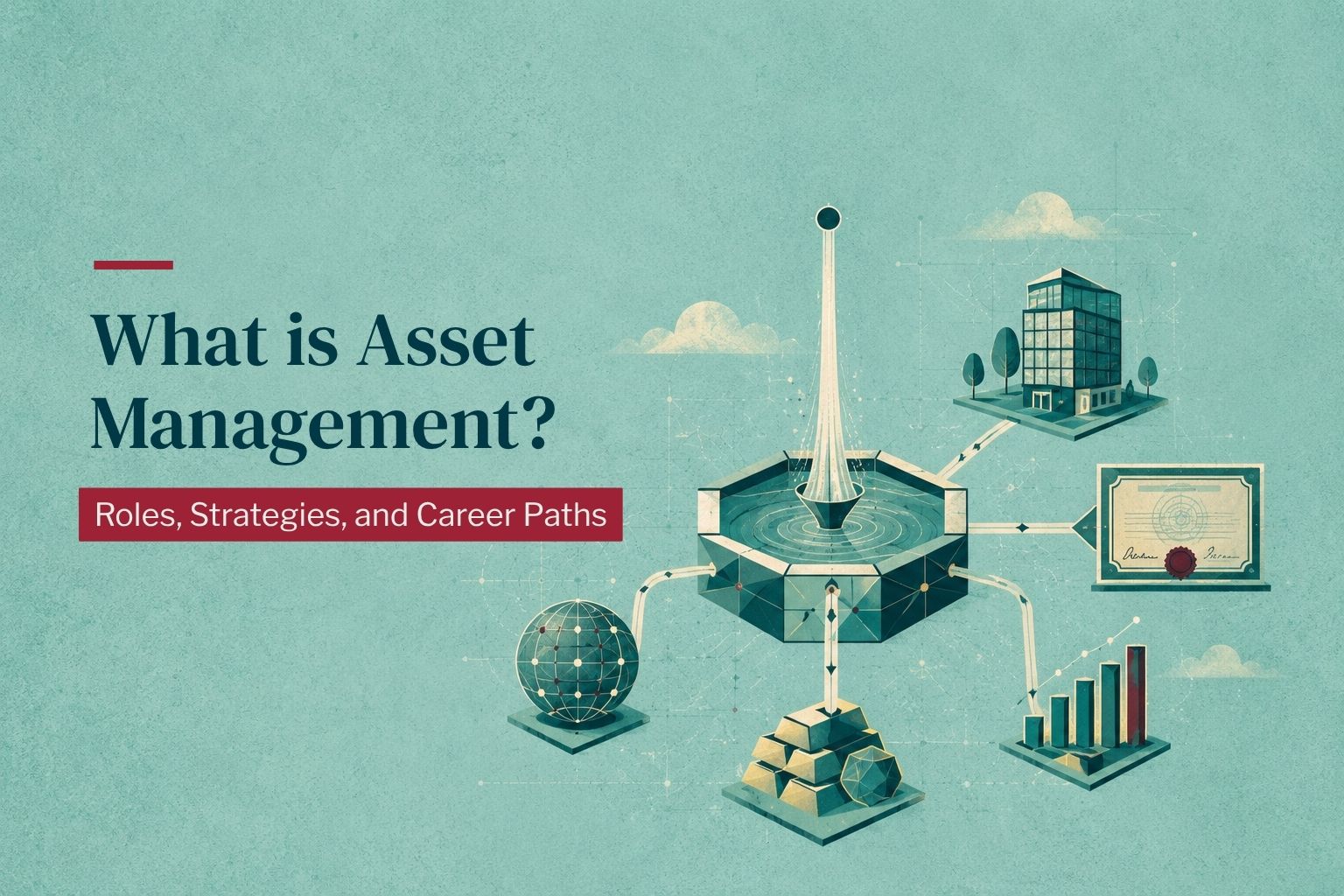
Asset management is the largest and most stable segment of the buy side. It is also the most varied. The industry stretches from passive index providers managing trillions of dollars in low-cost ETFs to active boutiques managing concentrated stock-picking portfolios for institutional clients. Most people who work in finance interact with asset management at some point in their career, whether as employees inside an asset manager or as clients of one. This guide explains what asset management actually is, what kinds of firms make up the industry, and what kinds of roles exist inside them.
An asset manager invests money on behalf of clients in exchange for a fee. Clients range from retail savers to pension funds, endowments, sovereign wealth funds and insurers, and the manager invests that capital according to a defined mandate.
The simplest definition
An asset manager is a firm that invests money on behalf of clients in exchange for a fee. The clients can be individual retail investors saving for retirement, high-net-worth families with multi-generational wealth, or institutional investors such as pension funds, endowments, sovereign wealth funds, and insurers. The asset manager promises to invest that capital according to a defined mandate (asset class, geography, style, benchmark) and to deliver returns measured against that benchmark over time. Fees are typically charged as a percentage of assets under management, often called AUM.
The scale of the industry
The largest asset managers in the world now manage trillions of dollars each. BlackRock alone manages over ten trillion. Vanguard, State Street, Fidelity, JPMorgan Asset Management, and a handful of others each manage between one and ten trillion. Concentration has increased over the past two decades as passive products and platform scale have rewarded the largest firms. Tens of thousands of smaller boutiques continue to operate in specialised niches.
The two big philosophies, active and passive
Modern asset management is split between two fundamental approaches. Active management tries to beat a benchmark by selecting investments deemed more attractive than the market average. Passive management accepts the benchmark return by holding all of its constituents in proportion to their index weights, at very low cost. Over the past two decades, passive has grown from a small fraction of the industry to a dominant share, driven by extensive evidence that the average active manager does not consistently beat the benchmark net of fees. Active strategies continue to thrive in less efficient markets including small-cap equities, high-yield credit, emerging markets, and most alternative asset classes, where information edges are more durable.
The major firm types
The industry contains several distinct firm models, each with its own client base, fee structure, and culture.
Large diversified asset managers. Firms such as BlackRock, Vanguard, and Fidelity offer products across asset classes and styles at scale, including mutual funds, ETFs, and separately managed accounts.
Boutique active managers. Smaller firms with concentrated strategies, often focused on a specific style (value, growth, quality) or sector. Examples include Ruane Cunniff, Tweedy Browne, Polen Capital, and many others.
Wealth managers and private banks. Firms that provide tailored portfolios to individuals and families, often combining asset allocation with tax, estate, and financial-planning advice. Examples include Morgan Stanley Wealth Management, Bessemer Trust, and Northern Trust.
Insurance-affiliated asset managers. Firms that manage the general account assets backing insurance liabilities. PIMCO (within Allianz), MetLife Investment Management, and Voya are examples.
Sovereign wealth funds and pension funds. Increasingly, the largest of these institutional investors manage substantial portions of their assets internally rather than outsourcing. CalPERS, the Norwegian sovereign wealth fund (NBIM), and Singapore’s GIC and Temasek all manage significant portfolios in-house.
The major roles inside an asset manager
Investment roles include portfolio manager (the final decision-maker on what goes into a portfolio), research analyst (who studies industries and companies and forms views), trader (who executes the portfolio manager’s decisions in the market), and risk manager (who monitors exposures and limits). Beyond the investment team, asset managers employ large teams in client relationship management, marketing, product development, technology, compliance, and operations. Front-office investment teams are typically the smallest groups by headcount but generate the firm’s intellectual capital.
Compensation and lifestyle
Asset management compensation is competitive but typically lower than the highest tier of private equity or top-performing hedge funds, and broadly similar to or modestly below investment banking in the early years. The trade-off is sustainability. Hours are more predictable. The work allows for genuine intellectual depth over a multi-year horizon. Career progression is structured but slower than the up-or-out culture of banking. Most senior portfolio managers earn meaningful seven-figure compensation; the very best portfolio managers at top firms can earn far more.
How to enter the industry
The most common entry pathways are an investment banking analyst programme followed by a buy-side move, a sell-side equity research role followed by a buy-side analyst seat, a direct entry into an asset manager’s analyst or associate programme out of university, or an MBA followed by a portfolio-manager-track role. The CFA charter is the dominant professional credential in asset management and is held by a large share of investment professionals.
How NYIF prepares candidates for asset management
The technical foundation for asset management is rigorous valuation, portfolio theory, performance measurement, and risk analysis.
The NYIF Portfolio Management Professional Certificate ($1,590, 35 hours total, 35 CPE credits, NASBA approved, available in online self-paced, virtual part-time, in-person, virtual live, and hybrid formats) is the most directly aligned program. The five-module curriculum covers Fixed Income Portfolio Management (7 hours: duration, credit analysis, bond strategies), Equity Portfolio Management (6 hours: valuation, diversification, beta), Hedge Funds (7 hours: strategies and industry infrastructure), and Portfolio Management Theory and Practice Parts I and II (14 hours combined: performance measurement and attribution, mutual funds, ETFs, retirement planning). The performance measurement and attribution emphasis is particularly relevant for analysts moving toward portfolio-manager roles.
For candidates moving from a non-finance background, the Capital Markets Professional Certificate (5 days, $1,590 online self-paced to $4,450 in-person, 35 CPE credits) builds the foundational asset-class fluency that asset management interviews assume.
Browse the next available cohort on the 2026 course calendar.
People Also Ask
How is asset management different from wealth management?
Asset management focuses on investing pooled capital against a defined mandate. Wealth management focuses on tailored advice to individuals and families, often combining investment management with tax, estate, and financial-planning services.
What is the difference between AUM and AUA?
Assets under management (AUM) are the assets a firm actively invests on behalf of clients with discretionary authority. Assets under administration (AUA) are assets a firm services but does not necessarily invest with discretion.
Do passive funds always beat active funds?
In US large-cap equity over multi-year horizons, mostly yes net of fees. In less efficient markets such as small caps, high-yield credit, and emerging markets, active managers have historically added value more reliably.
What is alpha versus beta?
Beta is the return earned by simply taking on market risk. Alpha is the return earned in excess of that, attributable to skill rather than to market exposure.
How do mutual funds and ETFs differ?
Both pool investor capital across a portfolio. Mutual funds price once per day at net asset value. ETFs trade intraday on exchanges. ETFs are generally more tax-efficient in the United States due to the in-kind creation and redemption mechanism.
Continue Your Finance Education
Ready to Advance Your Finance Career?
Browse NYIF courses in capital markets, risk management, financial modeling, and more.
Browse the 2026 Course Calendar →