
Bonds vs Equities: How the Two Asset Classes Actually Differ
Bonds and equities are the two foundational asset classes of modern finance. Together they account for the overwhelming majority of capital allocated by pension funds, sovereign wealth funds, insurance companies, university endowments, and individual investors. Anyone serious about working in finance, or about managing personal investments thoughtfully, needs a clear mental model of how the two differ, how they behave in different economic environments, and how they fit together inside a portfolio. This guide builds that comparison from the ground up.
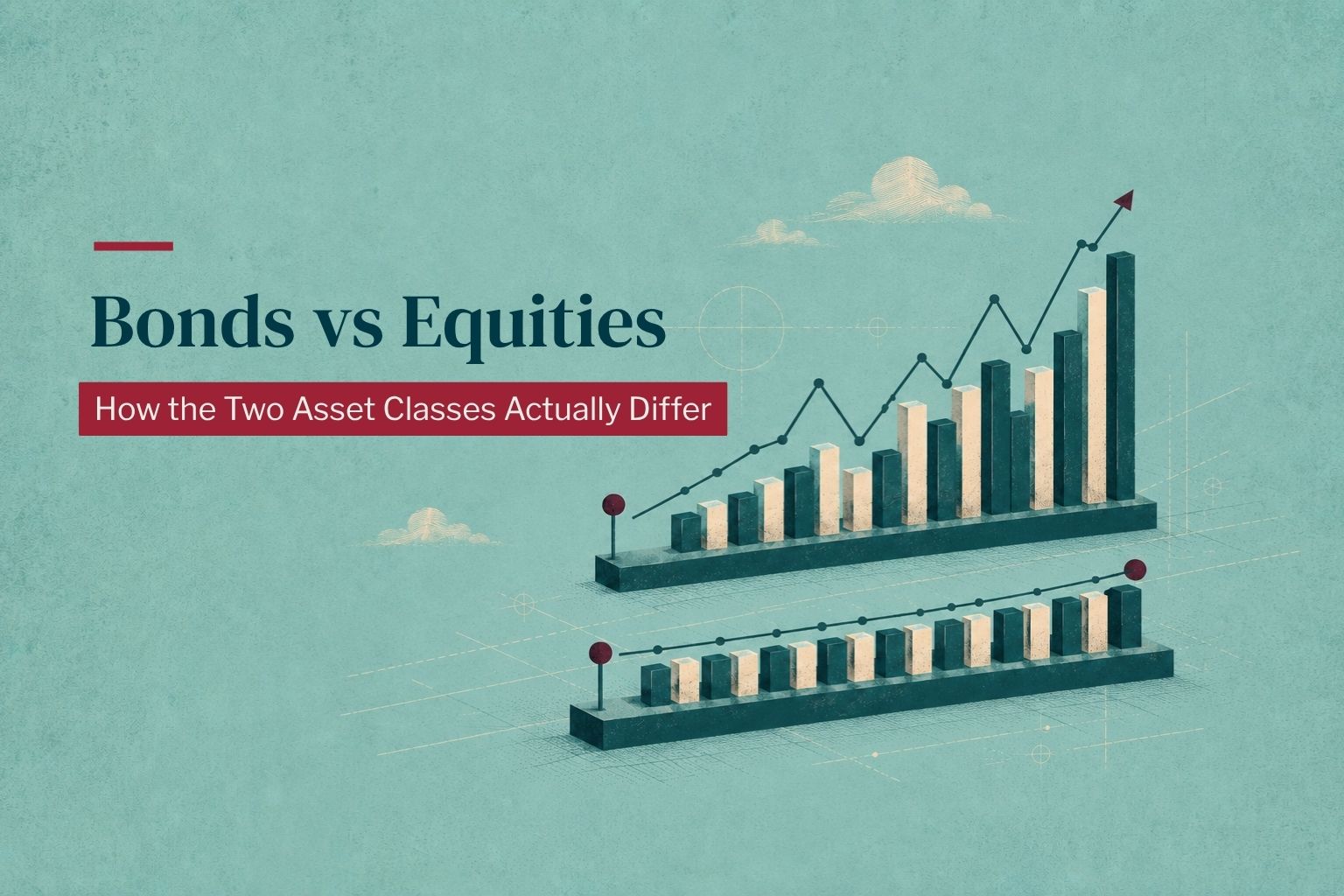
A bond is a loan: you lend to an issuer in exchange for scheduled coupons and the return of principal at maturity. An equity is ownership: you own a slice of the company, with unbounded upside, no promised payment, and last claim in a bankruptcy.
The core distinction
A bond is a loan. When you buy a bond issued by a corporation, a government, or a municipality, you are lending money to that issuer in exchange for a defined schedule of interest payments (the coupons) and the return of your principal at maturity. An equity, or share, or stock, is ownership. When you buy a share of a company, you own a small slice of the company itself, with the right to participate in its future profits and, in most cases, to vote on major decisions. The bondholder is a creditor; the shareholder is an owner. That single distinction drives most of the differences that follow.
How returns are generated
Bond returns have two components: the coupon income paid by the issuer, and any change in the bond’s market price between purchase and sale. Equity returns also have two components: dividends paid by the company (if any), and any change in the share price. The mathematics of bond pricing is well-defined and largely deterministic: bond prices move predictably with interest rates and credit spreads. The mathematics of equity pricing is more open: share prices depend on the market’s expectations about future earnings, which in turn depend on a much wider set of variables that resist precise modelling.
Risk profile, side by side
The standard intuition holds that bonds are safer than equities. That is true on average over long periods, but the picture is more nuanced. Investment-grade government bonds from large stable economies sit among the lowest-risk assets in finance. High-yield corporate bonds, especially those issued by leveraged borrowers in cyclical industries, can carry risk profiles closer to equity. Equities of stable, profitable, dividend-paying companies can be less volatile than the bonds of a distressed corporate issuer. The right framing is not bonds versus equities; it is the specific risk profile of the specific instrument.
| Dimension | Bonds | Equities |
|---|---|---|
| Legal claim | Creditor | Owner |
| Income | Fixed coupon (mostly) | Variable dividend |
| Upside | Capped at coupon plus price gain | Theoretically unbounded |
| Downside | Default risk; principal at risk | Total loss possible |
| Priority in bankruptcy | Paid before shareholders | Paid last, often nothing |
| Typical long-run real return | 2 to 3% (high grade) | 6 to 7% (diversified) |
| Volatility | Lower on average | Higher |
| Tax treatment (US, simplified) | Coupons taxed as ordinary income | Dividends and gains often at lower rates |
Why portfolios hold both
Almost every long-term portfolio holds some mix of bonds and equities because the two asset classes typically behave differently in different economic environments. Equities tend to perform best when growth is strong and corporate profits are rising. Bonds, especially high-grade government bonds, tend to perform best when growth is weak and central banks are cutting interest rates. Holding both smooths portfolio returns and reduces the depth of drawdowns during difficult years. The 2022 period was a useful reminder that the correlation can flip; both asset classes fell together when inflation forced rate hikes, which is why thoughtful portfolios also hold inflation-protected and alternative exposures.
How allocation changes through life
A young investor with a thirty-year time horizon and stable income can usually afford to hold mostly equities, accepting higher volatility in exchange for higher long-term return. As the investor approaches a major goal such as retirement, a house purchase, or a liquidity event, the allocation typically shifts toward bonds to preserve capital and to reduce the chance of a deep drawdown immediately before the funds are needed. Institutional portfolios follow analogous logic, adjusted for their specific liability profile. A pension fund matches assets to its expected payouts; an endowment balances current spending against the need to generate perpetual income.
Bond mechanics in plain English
Bond prices and yields move in opposite directions. When rates rise, the prices of existing bonds fall, because new bonds offer higher coupons and the old bonds need to discount to compete. Duration measures the sensitivity of a bond’s price to a change in interest rates, commonly measured for a one-percentage-point, or 100-basis-point, move; longer-duration bonds move more. Credit spreads, the extra yield that corporate bonds pay over comparable government bonds, widen when credit concerns rise and tighten when sentiment improves. These mechanics are what professional fixed-income investors actually trade around.
Equity mechanics in plain English
Equity valuation rests on the present value of future cash flows, which is why discount rates (and therefore interest rates) affect equity prices too. Multiple expansion (an increase in the price-to-earnings ratio) and earnings growth are the two drivers of long-run equity returns. Active equity investors spend their time forming views on how either or both will evolve at the company, sector, or market level.
How NYIF prepares candidates for fixed income and equity work
The NYIF Fixed Income Professional Certificate ($1,590, 31 hours, available online self-paced, virtual part-time, in-person, virtual live, and hybrid) covers Fixed Income Mathematics, Fixed Income Instruments and Markets, and Yield Curve Analysis. Topics include bond pricing mathematics, zero-coupon bonds, duration and convexity, corporate bonds, mortgage-backed securities, interest rate swaps, credit derivatives, and yield curve bootstrapping. The no-arbitrage pricing framework forms the curriculum’s analytical backbone. Learners gain the ability to reproduce yield and risk measures on Bloomberg YAS screens for government bonds. Prerequisites include intermediate Excel, elementary calculus, basic probability, and familiarity with fixed income instruments.
The NYIF Portfolio Management Professional Certificate ($1,590, 35 hours total, 35 CPE credits, NASBA approved) sits naturally above the asset-class certificates and teaches how to combine fixed income, equities, hedge funds, and alternatives into coherent portfolios. The five-module curriculum covers Fixed Income Portfolio Management, Equity Portfolio Management, Hedge Funds, and Portfolio Management Theory and Practice (Parts I and II), with particular emphasis on performance measurement and risk attribution.
Browse the next available cohort on the 2026 course calendar.
People Also Ask
Are bonds always safer than equities?
On average and over long horizons, yes. In any specific instrument, not necessarily. Distressed corporate bonds can be riskier than stable blue-chip equities.
What is the 60/40 portfolio?
A traditional balanced allocation of 60 percent equities and 40 percent bonds. It was the workhorse institutional benchmark for decades; recent volatility has prompted many investors to layer in alternatives and inflation hedges around it.
Do bonds always pay a fixed coupon?
Most do, but floating-rate notes, inflation-linked bonds, and zero-coupon bonds exist. Each has a different sensitivity to rate and inflation movements.
Can I lose money in government bonds?
Yes, especially if interest rates rise sharply or if you sell before maturity. The principal is contractually returned at maturity, but the market value in the interim can fall meaningfully.
Which asset class performs better in inflation?
Inflation typically hurts nominal bonds because the fixed coupon loses purchasing power. Equities can fare better if companies pass higher prices through to customers, but the relationship is not automatic; high inflation pressured both bonds and equities in 2022.
Continue Your Finance Education
Ready to Advance Your Finance Career?
Browse NYIF courses in capital markets, risk management, financial modeling, and more.
Browse the 2026 Course Calendar →